Sunday, 6 May 2012

Hung Parliament, 1974 version: what happened inside No.10

The late Gerald Moggridge
The following article is an extract from An English Family 1680 to 2009 by my father, the late Gerald Moggridge, to be published very shortly.


Gerald Moggridge, a Downing Street press officer at the time, describes the drama that was played out within No.10, from Friday 1 March 1974 (the day after polling day) until its conclusion late in the evening of Monday 4 March 1974.   

Most civil servants would think themselves fortunate to serve at No. 10 during a general election.  I was lucky enough to witness the beginning and the outcome of not one, but two general elections during my five years there. The first of them was the General Election of 28 February 1974. It brought about an unexpectedly tight result between the two major parties and produced a situation that had all the same ingredients that are now preoccupying everyone at the end of the May 2010 general election.

There is no escaping the drama and, in a real sense, the potential for tragedy that faces a Prime Minister in this position. Whoever you are in No.10, and whatever your politics and the politics of the serving Prime Minister, you feel considerable sympathy and sadness for the person who may soon be leaving by that famous front door for the last time.  I write with experience that, whatever your politics and whatever the Prime Minister’s politics, you will have developed an allegiance to and an affection for the man  (or woman) who, as the song says and the record shows - took the blows and did it their way.   Yes, there were to be tears in Downing Street on the evening of 4 March 1974.

But before that there were to be three days of high political tension and drama as Edward Heath and his party sought to reach some kind of an agreement with the Liberal Party to see if together they could form  “an administration which could  carry on the business of government.”   Throughout the weekend the press office was directly involved in both announcing and keeping an accurate record of the ebbs and flows of those negotiations . This we did through the series of ”press office bulletins”  (“pobs”) that had been part of the machinery of the Downing Street press office operation for some years. The first ”pob”  of this crisis - No. 89/4 dated Friday 1 March - confirmed that the PM had arrived at No. 10 (from Sidcup) at 0300 hours that morning and had watched the election results on television for a little while before going to bed.  He had breakfast at 0930 and then held a series of ad hoc meetings with various ministers.  A later ”pob” dealt with a story that Arthur Hawkey of the London Evening Standard had picked up to the effect that the PM’s doctor had called in at No.10 that morning. We confirmed that this was true, but that the doctor was not called in by the PM. He just looked in. (He - Dr Brian Warren - was a personal friend of Edward Heath). We later denied a BBC report that the Prime Minister was to hold a press conference at 1500 hours that day.

Then came the major announcements of the day. At 1940 hours we told the Press Association and the lobby correspondents that the PM had chaired a meeting of the cabinet and that “The Queen has granted the Prime Minister’s request to her to grant him an audience at 1945 hours so that he can report on the current political situation”.  In the feverish atmosphere that was now developing every word we uttered triggered a host of supplementary questions. The main one was ”Is the PM going to the Palace to submit his resignation?” The answer to that was a blunt ”No”. The following day - Saturday 2 March - the pace quickened when the PM had his first meeting with the Liberal leader, Jeremy Thorpe.  Any guidance? ”No commitment was entered into on either side.  The atmosphere was friendly and easy”. Full stop. More speculation followed on Sunday 3 March when we announced that there would be a meeting of Ministers in No.10 that evening, and a  further meeting with Jeremy Thorpe. 

The last act. Sunday 3 March saw a further meeting of Ministers and, at 2300 hours, what was to be the PM’s final meeting with Mr Thorpe. Monday 4 March dawned. There was now a tangible sense of events moving inexorably, to a conclusion - as in a Greek tragedy. We arrived in the press office early that morning, to be ready to announce a meeting of the cabinet at 1000 hours. The meeting lasted two hours. Soon afterwards the lobby were reporting that a meeting of the Liberal Party was taking place in the House of Commons.  Later we confirmed that the Prime Minister had received a letter from Mr Thorpe together with a copy of a statement issued by the Liberals. There was a further meeting of the cabinet. It ended at 1720 hours.

The stage was now set for the last act in the drama.  Three people had been selected to play supporting roles. In alphabetical order they were: a private secretary, Robin Butler**, a chief press secretary, Robin Haydon, and a chief press officer, me.  The script required Robin Butler and Robin Haydon to go across the road to the House of Commons and, with the prior agreement of John Egan, the chairman of the lobby, to position themselves in or near the lobby room  there. They would have with them a press statement and copies of the correspondence between Mr Heath and Mr Thorpe. From there Robin Butler would telephone my number in the press office at 1815 hours. He and I would then keep the line open until the moment I could confirm - by my view from the open door of the press office through to the hallway - that the Prime Minister had arrived at the front hall and was, literally, “on his way out of No. 10”. On that signal, he and Robin Haydon would release the press material to the lobby correspondents, and brief them on its contents.

And so it was that, at 1820 hours on Monday 4 March 1974, it was announced that Edward Heath’s period at No.10 had ended. My last act for the Prime Minister, after I had passed that telephone message to Robin Butler, was to record Mr Heath’s departure in the press office bulletin for that day.  (For the record it was  “pob” No. 92/4). It bore my initials and gave the text of the press notice which, in nineteen words, formally brought to an end the premiership of Edward Heath.  It read: ”The Prime Minister has sought an audience of Her Majesty in order to tender the resignation of the Government”.   
The rules say there must be no interregnum. Some two hours later the new Prime Minister, the Right Honourable Harold Wilson, OBE, MP, entered No. 10 Downing Street.  That event, too, I recorded on a press office bulletin. Clearly, there must be no interregnum  The King is dead. Long live the King.

** Now Lord Butler of Brockwell.


Tuesday, 14 February 2012

Is it just me or are Kindles annoying?


I’ve never really seen myself as a Luddite, but of late I’ve found myself getting a little inwardly frustrated whenever I’m in a supermarket and one of the staff tries to direct me towards the automated check-outs. I feel as if I should say to the person concerned, “What are you doing? You’re standing there putting yourself out of a job! Why do you want me to use the automated check-out? You should be advising me to use a human being, not a machine, and that way you’ll still be in work. Carry on promoting the auto-check-outs and soon you’ll be receiving your P45.”
Go and buy a proper book! Most people seem to use Kindles on the move.

But I say nothing, although I have started to refuse them when they beckon me over. For a start, I find them quite difficult to use and I can’t be bothered to try and learn. Why should I? All I want is human interaction, I like to chat with the check-out assistant, put my debit card in the machine, refuse or accept cash back and then bid them a cheery farewell.

If the supermarkets get their way, there won’t be any check-out assistants, just machines with, perhaps, one member of staff overseeing the process. What is already a chore will become a nightmare and one really has to think about the aims and objectives of the supermarkets. Are they trying to make the whole process so unbelievably dull that we all shop on-line instead? Probably, although shopping on-line I can cope with: you log on, order your weekly shop and then, hey presto! It turns up in a little orange van. It’s cheaper too because there are no temptations, but then I start to think about all the people that will be put out of work by on-line shopping as it means there’s no need for a store, so they won’t need store managers, shelf stackers, you name it – they’ll all be out of work.

And even if they don’t abolish supermarkets, those who like seeing what’s on the shelves will have to cope with the automated check-outs and all the grief they bring.

That aside, though, it’s the ignorance of the staff that gets me: the way they stand around watching people grow more and more accustomed to an automated process that will, ultimately, put them on the dole queue. The supermarkets will argue that it frees up the staff to do something more productive instead, but that’s just a lie. The idea is simple: if they can get a machine to do a cashier’s job, they’ll save money and that, of course, is what it’s always about: saving money. The customer isn’t really king; that’s a lie too. And then, when the customers decide they’d rather shop on-line, we’ll see derelict supermarkets being turned into over-sized bars and restaurants and casinos by over-ambitious leisure operators – not good.

Sadly, of course, nobody cares, not even the ignorant people who stand to lose their jobs. They are so grateful they have a job in the first place, they’re happy to promote automation and risk losing the only job they have.

On a similar note, I get really angry when I see somebody on a train – or anywhere – reading a Kindle. I can’t stand Kindles! There’s nothing worse than reading anything on a screen and I always feel that owners of Kindles are part of some kind of conspiracy, a conspiracy that leads to the end of books, printed books. Kindle users exist to get rid of books and make us all have to download novels rather than buy them from bookshops or borrow them from libraries. Hell! It means the end of bookshops and libraries because, as Kindle users will tell you, a Kindle allows you to carry the whole library with you on the train! Wow! Isn’t that great! No it’s not fucking great, you morons! 

Kindles take all the pleasure out of reading in the same way that music downloads take all the pleasure out of buying an album. I want to read the sleeve notes! I like the little booklet with the lyrics! I want to see photos of the band! And I like the tactile quality of a book too. I like bookmarks! I like looking at how far my bookmark has sunk through the book, how much I have left to read and how much I have already read! With a Kindle, all that is lost! It means that libraries, like supermarkets, will become ‘venues’ full of back bar fridges crammed with ‘premium priced lagers’.

Imagine reading War & Peace or Infinite Jest on a Kindle? You’d have no idea of where you were in terms of how much you’d read. Okay, you’ll have page numbers to tell you, but there wouldn’t be that sense of achievement that you get with a book and, after reading it, you wouldn’t be able to put it proudly on your bookshelf at home – instead it would remain on your Kindle, in your briefcase or handbag, and then one day, when the system crashes or burns out, you’d lose it forever.

The worst thing about Kindles, of course, is that they’re probably good for the environment. The phrase ‘woodman, spare that tree’ would be redundant and I’m sure that Kindle users will always bring up their mission to save the planet in defense of their new gadget.

If Kindles catch on, books will disappear and so will bookmarks and the home environment will become sterile and minimalist. Rooms would be bare and characterless except for furniture and a television set – and a digital picture frame on the sideboard.

I don’t want to curl up with a Kindle. I want to read a book in front of the fire without worrying that I might melt my new reading gadget.

I often feel like asking a Kindle owner why. Why have they got one? Was it a present? Or did they go out and buy it themselves? They would probably say something like, “It’s the future. It’s the way things are heading.” And, prior to punching them, I’d feel like saying, “Only because you’re letting it happen.”

I hope I’m not alone in my anti-Kindle feelings. I don’t think I am. I just hate the way things are becoming so sterile and insular. We can stay behind closed doors and order our shopping online instead of mixing with real people at the supermarket or in the high street. We can download our books from computers at home rather than visit a bookshop where we could enjoy a cup of coffee and possibly meet with friends. Everything can be done from the safety of our own homes. We all communicate using social networking sites instead of meeting in the pub for a beer. We’re losing our sense of community.

A couple of years ago I boarded a train to Winchester with a work colleague and, once aboard the train, he said to me: “Do you mind if I sit over there and play my PSP?” Of course I didn’t mind, but what he meant was: I hope you don’t mind, but rather than engage you in conversation, I’d like to play Grand Theft Auto on my portable games device. This guy queued up overnight to be one of the first to buy the latest edition – sad or what? He was (and probably still is) such a nobhead! I told him to feel free and he went and sat at the other end of the carriage for the entire journey so that I wouldn’t disturb his gameplay.

Thursday, 26 May 2011

Eulogy for Dad...

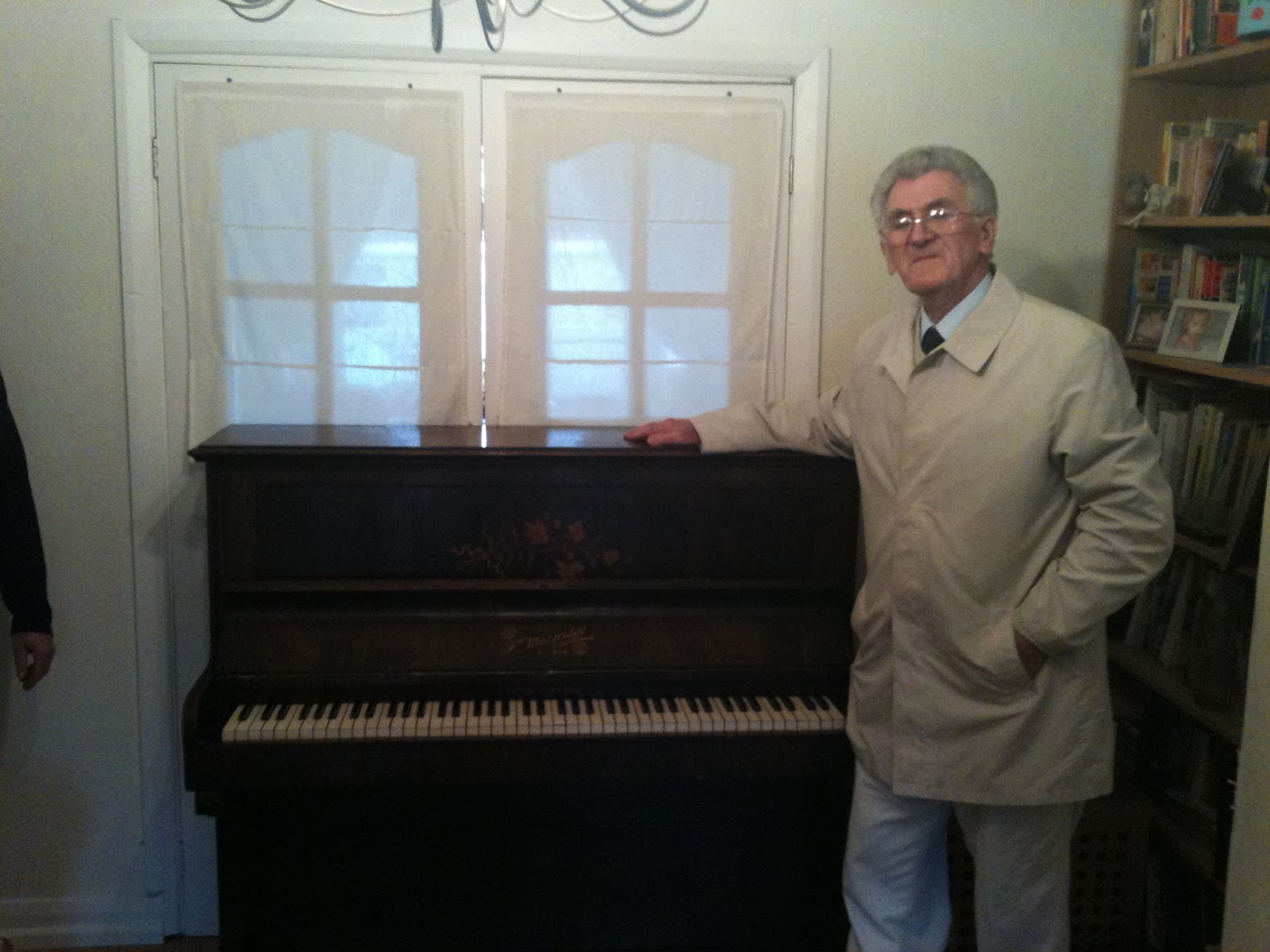
Dad with a Moggridge piano, March 2010.
Funerals can be gloomy occasions, but the word ‘gloomy’ is not an adjective I would use to describe the man whose life we are celebrating and whose passing we mourn today. Dad was full of positive energy and optimism for life. He possessed an immense enthusiasm for everything and, while he probably wouldn’t admit to it himself, he was a true perfectionist.

Even his initials spell out the nature of the man: Gerald Eldred Moggridge can be shortened to GEM and for all of us, dad was a real gem of a husband, a father, a grandfather and, of course, a great grandfather.

Mum will tell you what a great husband dad has been; they were married for 56 years, had three great kids, including me, and there was never a cross word – well, one or two, perhaps. Dad loved being at home with mum and was fortunate to enjoy 22 happy years of retirement, tending to their amazing and inspiring garden and researching and writing a history of the Moggridge family – available in all good bookshops soon.

As a father, dad was second to none. He probably wasn’t that good with dollies and teddies – that’s why Criss was forced to squeeze one of her dolls into Action Man fatigues – but our early years were characterised by cap guns, forts, train sets and toy soldiers and the biggest kid of all was dad. He taught us how to make log cabins out of sticks and blow them up with bangers and he was definitely behind the legendary Battle of Kiln Castle, which I’ll explain later to anyone who wants to listen.

Our childhoods were defined by two key events: summer holidays on the South Coast at Middleton-on-Sea and Felpham where dad played King Canute in a sandcastle; and, of course, Christmas time. Dad made both occasions truly magical – so much so that we’d be walking around the block, counting the days to our summer holiday, months before boarding the train to Bognor; and we probably believed in Father Christmas for longer than most kids – thanks to a bell and a ball of string.

Dad rigged up a bell outside of our bedroom window. It was attached to a ball of string, which he threw into the garden and then back through the bathroom window. On Christmas Eve, we would be tucked up in bed and dad would stand by the door clasping and pulling the string, ringing the bell outside the window. For years, we were believers – until I found the bell.

Dad also shone outside of the home. He enjoyed a highly successful career in the Government Information Service where he worked in Number 10 Downing Street alongside two great British Prime Ministers – Harold Wilson and Ted Heath – as well as one legendary Prime Minister-in-waiting, Margaret Thatcher (when she was Minister for Education). He set up the press office at the Lord Chancellor’s Department and was a regional director of the COI, in charge of co-ordinating media activity surrounding Royal Visits. He worked with the late and equally legendary Princess Diana and other members of the Royal Family.

Dad has met some of the world’s greats, including former American president Richard Nixon, in Bermuda with Ted Heath, and the diplomat’s diplomat, Henry Kissinger.

Which brings me to dad’s other enduring qualities – his strong moral code and his ethical approach to life. Dad was a fair man with a strong sense of right from wrong. Over the years, he provided us all with what I can only describe as expert guidance on how to live our lives – standing here today, I can confirm that he did a brilliant job and we will all miss him.

Wednesday, 6 April 2011

What a drag it is getting old...


Last night Panorama screened a programme about ageism in the workplace. Talk about the pot calling the kettle black! The BBC is renowned for being ageist as the recent case concerning Miriam O'Reilly, a Countryfile presenter, proved; and let's not forget countless other people who have been told they're too old to be on the beeb – Moira Stewart was one and then there was Arlene Phillips, who was replaced by Alesha Dixon. 


Arlene Phillips knows more about dancing than Alesha Dixon, but because Dixon is younger than Philips, the beeb thinks that people sitting at home in front of the TV would rather stare at Dixon than Phillips. We're not THAT shallow, are we?


Phillips must have been inwardly fuming over that scandal, but surely Dixon is secretly thinking, "I'll be next" as she stares pensively into her bathroom mirror, checking for any early wrinkles.

The problem with the BBC's ageism policy is that it's sexist. Strictly Come Dancing's Len Goodman and Bruce Forsyth, for instance, are both really old men – Brucie is in his 80s – but they are still going strong and if you take a look at Newsnight, good old Paxo, now white-haired, is as stroppy as ever. Mind you, I'd rather have Paxo presenting a heavyweight current affairs programme than Adrian Chiles or Dominic Littlewood.

Fortunately, Panorama chose Fiona Phillips to present its ageism programme, probably because she's no spring chicken, although she scrubs up well, to coin a phrase. Philips turns 50 this year and I guess she was chosen to quieten down the beeb's critics who would have been in uproar had Fearne Cotton been the chosen presenter – and rightly so.

The programme focused on a real problem: the fact that employers in the UK don't want people in their 50s working in their companies. 

When you're in your 50s you just want to do your job to the best of your ability and get paid for it; you're not going to suck up to the boss, not only because he or she will probably be younger than you are, but because you know that it's not the way to conduct yourself and you've realised that you work to live, not live to work.

Panorama focused on four people: three men and one woman, all of whom were out of work and having real problems finding a job. Why? Because they're considered to be past it. All four of them have been trying to get work for a very long time, but they've failed despite being well qualified for the roles in question.

What I found really annoying – alright, I found it really irksome – was the absolutely useless presence of Digby Jones. That man failed to grasp the problem and spent any airtime he was given patronising four decent people who already felt bad enough about their lot and certainly didn't need Baron Jones of Birmingham telling them what do.

Jones got it completely wrong. If you're reading this, 'Baron', the point of the programme was this: people in their 50s – qualified people who might have studied hard to become professionals in some sphere or other – are being turned away from jobs that they want to do and for which they are more than qualified. They want to do the job but one thing stands in their way – their age.

But did Jones grasp it? No, he didn't. "Why don't you re-train, become a plumber?" he said as the hapless individuals were given a patronising one-by-one audience with the Baron, who resembled a poor man's Wizard of Oz, after the curtain had been pulled back, and our four 50-somethings were, perhaps, Dorothy, The Tin Man, The Lion and the Scarecrow.

That's not the point, Mr Jones, they don't want to become minicab drivers, driving instructors or plumbers. Why would they? They want to remain as accountants or teachers and they're perfectly capable but they are being stopped by employers who are more concerned about saving money or, in the case of the Beeb, with cosmetic issues. 

What I also found rather amusing about the Panorama programme was the occasional input from Age UK, a charity that is obviously anti the whole ageism thing. Sadly, though, the charity's representative was a young bloke who was definitely not in his 50s – they missed a big trick there.

There was no happy ending to the programme either. I was expecting written announcements prior to or during the end credits, stating that the programme's subjects had all found work in their chosen fields, but no, they hadn't. One resorted to voluntary work, the other considered turning a hobby (picture framing) into a job and another – who was sent to work in a bar – gave it up because he felt it was below him. The female former teacher had started her own business, but it all went wrong for her when she lost a contract.

The big problem for the UK and its growing population of over-50s, is that while we're all being expected to work longer before we pick up our state pensions, there are people, like Digby Jones, who expect professional people to simply down tools at 50 (largely for cosmetic reasons) and accept jobs that aren't so important in a 'people-facing' sense. It's as if the general public as a whole – and employers and their workforces in particular – have some kind of aversion to people with a bit of white hair or a more wrinkled face and shouldn't have to endure looking at them for fear of being offended.

I was going to finish this article with the phrase 'grow up', but then I realised that growing up and getting older was the nub of the problem when it shouldn't be.

Napoleon once referred to the United Kingdom as a 'a nation of shopkeepers', but if things keep going the way they are, we'll be a nation of driving instructors and 'white van men' and newsagents windows will be inundated with 'man and van' cards.

Such a fate awaits us all and there must be thousands of people in college today wondering whether it's worth studying hard if they're going to end up stacking shelves in a supermarket or a DIY superstore. Why not simply leave college and go there now? That way you'll avoid disappointment later in life.

Monday, 27 December 2010

The Prestige, by Christopher Priest

Borden and Angier as portrayed by Christian Bale (left) and
Hugh Jackman.
Well, first of all, let's start with the fact that I bought Priest's The Prestige a long time ago, probably not long after it published in 1995; but, for whatever reason, I didn't read it – or rather I started and then put it down. It remained on my bookshelf for many years and is still there now, the difference being that, as of 26 December 2010, it has been read and, I must say, it's up there with the very best of all the books I've read. Why? Because of the way it was written, the fact that it was well-researched – or at least I assume it was – and because the characterisation is so rich and the story so authentically told. For a book set in the late nineteenth and early twentieth centuries, but written in the late twentieth century, it manages the conceal its youthful nature through the style of the writing, a lot of which is in diary form and conveys the thoughts of the two main characters – that of Alfred Borden and Rupert Angier – both of whom are magicians, one who calls himself the Professor de Magie and the other, The Great Danton.

In essence, the book documents the rivalry between the two men and how they each attempt, on numerous occasions, to sabotage the other's act. In fact, that word 'attempt' is misleading as Borden, more so than Angier, manages successfully to sabotage Angier's act and, in the process, causes him great harm. One of Borden's early attempts results in the loss of Angier's unborn child, although later he inadvertently saves Angier from drowning when one of his illusions goes wrong.

The main theme of the book, however, is the quest of both men to discover the secrets of each other's main illusion, that of teleportation from one location to another. In Borden's case we discover that body doubles are involved in his New Transported Man, something Angier finds hard to believe (although it turns out to be true). Subterfuge is involved when Angier's wife defects to the 'other side' by working for Borden, initially to find out his secrets, but ultimately she falls in love with him and sends Angier a false lead after admitting her original intentions to Borden.

Angier receives a note from his wife informing him that the secret of Borden's act lies in the work of a Professor Tesla who is experimenting with alternating current in Colorado. Angier travels to the USA and asks Tesla to manufacture a machine that will enable him to transport himself from one place to another – in other words, not an illusion but a reality: a machine that literally transports matter from one location to another. Angier pays a hefty sum for the equipment and, for a while, appears to have been ripped off until he discovers that the paid-for equipment had been shipped and was probably languishing in a dockyard somewhere in the UK.

Once retrieved and assembled, the equipment does its job and Angier discovers that, without the aid of a body double – a method he does employ prior to meeting Tesla – he can transport himself from the stage to the circle seats of any theatre as long as it has electrical power. He manages to wow audiences the length and breadth of the country and becomes very rich in the process, but his great nemesis, Borden, is always lurking in the audience, trying to sabotage the act.

On one occasion he manages to somehow switch off the power of Tesla's apparatus at a crucial moment in the act when Angier has passed the point of no return. The end result is that two Angiers spring into existence, one being his original self and the other his part-transported self – a ghost-like wraith who decides that enough is enough and that he must kill Borden. But when push comes to shove, he can't do it. The 'other' Angier, the one that initially entered the Tesla machine, becomes ill and eventually dies.

It is important to remember, however, that Angier is also part of the aristocracy and so has two identities: one being Rupert Angier (The Great Danton) and the other Lord Colderdale of Derbyshire. With the Great Danton dead – and so, by default, Lord Colderdale, only the wraith-like Angier is left and he decides to end it all by using the Tesla equipment once more to re-unite himself with the other Angier who is now in the Colderdale mausoleum.

While most of the book is set in the mid-18th Century and early twentieth, the first and last parts are set in modern times. The book starts with a reporter – an unknowing descendant of Borden – visiting a descendant of Angier and explaining how he always feels he has an identical twin somewhere in the world. These feelings are strongest during his time in the Colderdale stately home and it is not until the end of the book, when the reader is back in the present day, that story reaches its rather eerie and frightening conclusion.

I loved this book and was elated to discover that my son Max had a DVD of the movie, which I sat down and watched last night (Boxing Day 2010) having finished the novel that morning. Sadly, although understandably, considering the novel's intricacies, the movie was considerably different from the book and nowhere near as good. Borden is portrayed as some kind of plucky cockney magician – not how I imagined him at all – and he and Angier see a darn sight more of one another than they do in the book (where most of their encounters are during acts of sabotage). The movie has Borden accidentally killing Angier's wife, when in the book he kills their unborn child. Unless I missed it, Borden is not shot by Angier and Borden is never in prison awaiting hanging. What's more the modern-day element of the story is completely ignored as is the eerie climax to the novel. All in all, while the book was one of the most impressive I've read in a long time, it was let down by the movie – but only, I'd imagine, for those, like me, who had read the book. Coming to the movie in isolation, it's a good film.

Thursday, 16 December 2010

Cycling and running boom shows appetite for sports participation

 New participation figures published by Sport England paint a mixed picture of progress in grassroots sport, with strong growth in running and cycling but a decline in other major sports, including football and swimming.  
Cycling has experienced strong growth in terms of participation,
claims Sport England
Overall, the slow but steady increase in participation numbers seen over the past five years continues, with 6,938,000 people now taking part in sport at least three times a week. Today’s Active People Survey results show that regular participation is now 123,000 closer to the Government’s aim to get one million people playing more sport by 2012/13.

Weekly participation in athletics (including running) has swelled by over 263,000 over the past two years, buoyed by a growing network of informal running groups across the country. Over the same period, cycling’s numbers are up by almost 100,000. British Cycling’s Chief Executive, Ian Drake, said:

“We put great stock on trying to ensure our participation initiatives truly meet the needs of those we’re hoping to get involved in our sport. Indeed, we can partly put the continued success of Sky Ride down to the fact that we listen to participants and adapt our offerings based on the feedback we receive. We’re committed to getting more people on their bikes and importantly, keeping them cycling. What is particularly exciting for us is that we’re confident there’s plenty more to come and throughout 2011 we will be launching more new initiatives to help get more people cycling more regularly.”

Netball’s participant numbers are up by over 26,000, an increase of a fifth in the size of the sport in two years. Much of this success comes from the Back to Netball programme, which tempts women to return to the sport with a fun and flexible offer.

This is just one of the initiatives that have contributed to a recovery in women’s participation in 2010, but the gender gap in sport remains a challenge.

Of real concern, however, is the continued under-performance of five of the top seven participation sports, including the only sports with more than two million weekly participants - swimming and football. Their size means that this decline has a major impact on the overall growth of grassroots sport.

For these two – and other sports such as cricket and rugby – the challenge is to arrest the drop in participation outside the club structures where they have traditionally focused most of their attention.

The past 12 months have also been a tough period for sports that are costly and time-consuming such as golf, sailing and skiing. There has been a marked drop in participation in these activities among men aged between 35 and 44, a key period of economic productivity in most people’s lives.

Sport England ’s Chief Executive, Jennie Price, said:

“It would be fair to describe today’s results as a mixed bag. It’s good to see a wide range of sports – from individual pursuits like running to small team sports like lacrosse - demonstrating that, with the right approach, increasing grassroots participation is a realistic ambition.

“What is concerning, however, is that a number of major sports have yet to deliver, despite significant levels of investment. They now urgently need to demonstrate their ability to grow participation in their sport and prove they can make a significant contribution to sport at the grassroots level.”

The Minister for Sport and the Olympics, Hugh Robertson MP, said:

“During the comprehensive spending review we fought hard to get a good settlement for sport, keeping the Whole Sport plans in place. Now it is vital to see a return from the investment sports get from the public purse. I want every pound that national governing bodies spend on the grassroots to count.

“Our recently launched ‘Places People Play’ strategy will help get more people participating but we also need sports governing bodies to step up to the plate and deliver. Some sports are making progress such as athletics and netball and we need to learn lessons from them to get growth across the board.”

Me and Martin 'Wolfie' Adams, the darts player...

Martin 'Wolfie' Adams and yours truly, Evesham, December 14th 2010.
Alright, I know, I'm a friend of the stars. Here I am in Evesham at a social club with darts legend, Martin 'Wolfie' Adams. I had a really tiring day as I journeyed down to Evesham by train, getting in at around 7.15pm, then I hiked over to the club, interviewed Wolfie and a few others, got back to the hotel, checked in around 10.30pm, had dinner (it was a great hotel, the Riverside, Evesham, right on the Avon and great staff, clean rooms etc) and then, up to the room to start writing the feature. Finished it at 0130hrs, emailed it to David, the designer, then went to bed. Got up at 0630, had a Full English at 0700hrs, went back to the room, wrote the products pages (this is Club Mirror magazine, by the way) then jumped in a cab to Evesham station, discovered that a bridge had collapsed so spent £40 on a taxi to Warwick Parkway and then over £30 on a ticket to Marylebone. Got home, had a Marmite sarnie, drove over to David's, passed the issue and got back home again at 6pm. Then, at 10.30pm went out to pick up Max from Gipsy Hill, not a very salubrious place to be on foot at night. Got to bed around 11.30pm.

The great thing about Martin Adams was that he, like me, was born and bred in Sutton, Surrey. We had a good old chinwag about Sutton pubs, what a great bloke!